
UNDERWATER FISHING GUIDE
Discover what happens between the cast and the catch.
You've found a promising fishing spot. You're casting your favorite lure, experimenting with retrieves, and watching your line for a bite. But there's one question you can't answer just by looking at the water: what's actually happening underwater?
An underwater fishing camera offers a different perspective. It lets you record underwater footage and review how fish interact with your lure, how your presentation looks, and what might be happening during a retrieve.
But is an underwater camera worth the investment? For lure anglers, the answer depends on what you want to learn, the conditions in which you fish, and whether you use the footage to improve your technique.
Is an Underwater Fishing Camera Worth It?
For anglers who enjoy experimenting with lures and learning from every fishing trip, an underwater fishing camera can be a useful tool. Its value goes beyond simply seeing fish. It helps you observe details that are difficult to see from the surface.
Imagine fishing a promising area without getting a bite. You might wonder whether fish are present, whether they are approaching your lure, or whether your retrieve is producing the action you expect. Underwater footage can provide clues that help you investigate those questions.
The main benefit: An underwater fishing camera gives you visual evidence to review after a cast, helping you make more informed decisions about lure presentation and fishing technique.
A camera cannot guarantee more bites. Water clarity, lighting, fish behavior, camera positioning, and the amount of footage you review all affect its usefulness.
If you enjoy understanding why fish react to certain presentations, recording underwater footage can add another layer to your fishing experience. If you want live sonar readings or rarely review video, another type of equipment may better suit your needs.
5 Things an Underwater Fishing Camera Can Help You Learn

1. How Fish React to Your Lure
A fish following a lure without striking is one of the most frustrating moments in lure fishing. From the surface, it's difficult to know whether the fish lost interest, approached out of curiosity, or never got close enough to bite.
Depending on visibility and camera positioning, recorded footage may show fish approaching, following, turning away, or ignoring a lure. These observations can help you decide what to test next.
Try changing one variable at a time: retrieve speed, pause duration, lure color, or presentation angle. Repeated observations are generally more useful than drawing conclusions from one encounter.
2. What Your Lure Actually Looks Like Underwater
A lure can behave differently underwater than you imagine. Retrieve speed, line tension, rigging, and current can all affect its movement. A soft plastic may roll unexpectedly, while a swimbait may produce a different action at different speeds.
An underwater camera can help you inspect these details. Record comparable retrieves and review the footage to understand how your setup moves through the water.
3. Whether Fish Are Using a Particular Area
Points, weed edges, submerged structure, and changes in bottom composition can influence where fish spend time. An underwater camera may reveal fish or habitat details within its field of view.
However, a recording only represents a limited area and period. Not seeing fish on camera doesn't prove that a location contains no fish. Fish may be outside the frame, hidden by cover, or difficult to see in poor visibility.
4. How Water Conditions Affect Your Footage
Clear water and adequate light may reveal more detail than muddy, shaded, or sediment-filled water. Understanding these differences helps you set realistic expectations for what a camera can capture.
Review footage from different locations and conditions to discover when your setup produces the most useful recordings.
5. Which Adjustments Deserve Another Test
A fishing camera is especially useful when you approach it as a learning tool. Compare different retrieve styles, lure choices, and presentation angles instead of changing everything at once.
Keep notes about the location, conditions, lure, and your observations. Over time, you may identify patterns that help guide future fishing decisions.
Watch Real SC100 Underwater Fishing Camera Reviews
Product specifications tell only part of the story. Seeing how an underwater fishing camera is used during an actual fishing trip can help you understand its workflow and decide whether it fits your style.
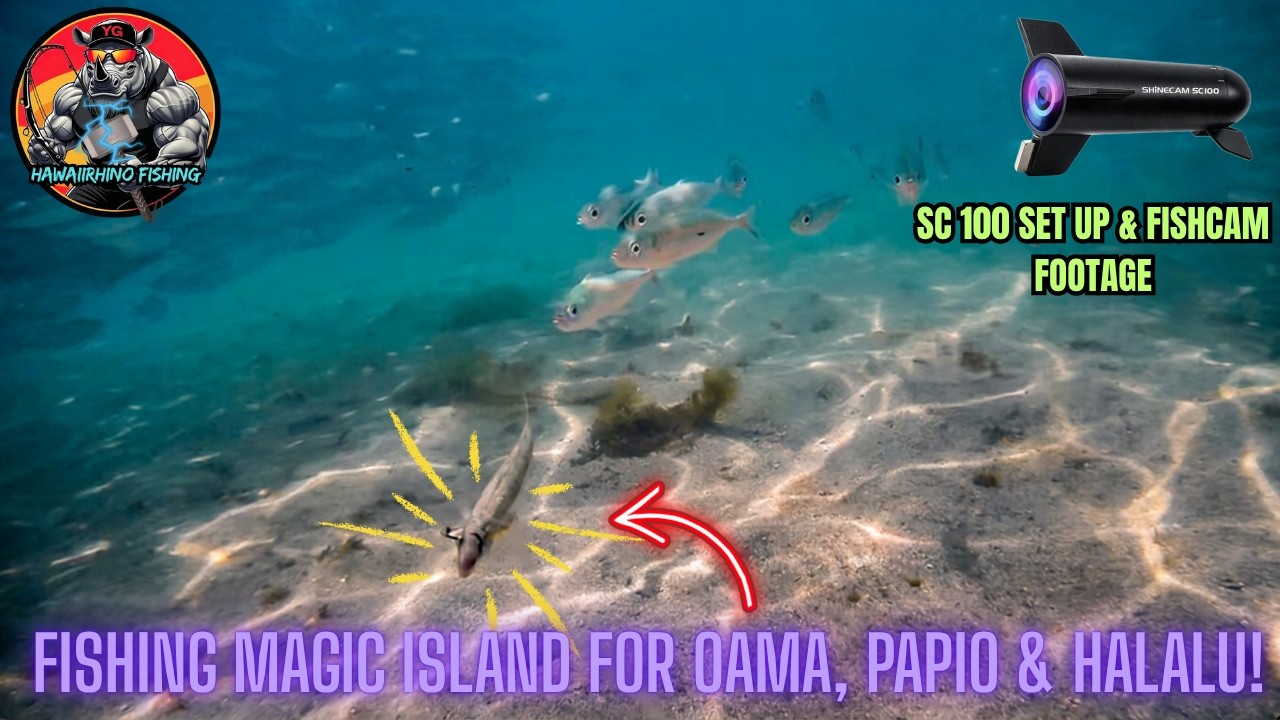
SC100 Review: Watch the HAWAIIRHINO FISHING review and see the product in a real fishing context. Watch on YouTube.
On-the-Water Review: Explore another SC100 review from a Mississippi River fishing perspective. Watch on YouTube.
When evaluating any fishing camera review, pay attention to the conditions, camera placement, recording quality, and how the footage is reviewed. Your own results may differ depending on water clarity, light, depth, and fishing technique.
Underwater Fishing Camera vs. Fish Finder: What's the Difference?
An underwater fishing camera and a sonar fish finder serve different purposes. Understanding that difference is important before choosing equipment.
| Feature | Underwater Fishing Camera | Sonar Fish Finder |
|---|---|---|
| Primary output | Visual underwater footage | Sonar information about underwater targets and structure |
| Fish appearance | May show visible fish and their movements | Displays sonar returns rather than ordinary camera images |
| Lure presentation | Can show how a visible lure moves underwater | Depends on sonar capability and setup; it does not provide ordinary video |
| Visibility limitations | Image quality depends on light, water clarity, and camera view | Performance depends on sonar technology, settings, and conditions |
| Typical use | Visual observation and footage review | Locating and interpreting underwater targets and structure |
Important distinction: The Shinecam SC100 is designed to record underwater footage for review after retrieval. It should not be confused with a real-time sonar fish finder or advertised as a live fish-location display.
If your goal is to see how fish interact with a lure, visual footage offers information that sonar readings alone cannot provide. If your priority is real-time sonar information, compare fish finder options separately.
What an Underwater Fishing Camera Can't Do
Before purchasing an underwater camera, understand its limitations. Knowing what a device cannot do is just as important as knowing what it can do.
- It cannot guarantee a catch. Fish behavior depends on many factors, and video cannot reveal every reason a fish does or doesn't strike.
- It cannot see through every condition. Sediment, vegetation, low light, and poor visibility may obscure the image.
- It only records what enters the frame. Fish outside the camera's field of view may never appear in the footage.
- Recorded footage isn't necessarily live viewing. Check the recording and viewing method before purchasing.
- It doesn't replace fishing experience. Footage is most useful when combined with observation, experimentation, and repeatable tests.
Think of an underwater fishing camera as a complementary tool. It provides another way to observe your fishing environment, but it doesn't remove the uncertainty that makes fishing challenging.
How to Choose an Underwater Camera for Fishing
Not every underwater camera is designed for the same purpose. A stationary observation camera may have different requirements from a compact camera intended to accompany a lure during casting and retrieval.

1. Match the Camera to Your Fishing Style
Lure anglers should consider attachment, handling, camera placement, and whether the device is designed to travel with their fishing setup. Think about how it fits into your existing casting and retrieval routine.
2. Check Resolution and Image Quality
Full HD 1080p recording can provide useful detail for reviewing visible fish behavior and lure presentation. However, resolution is only one part of image quality. Lens performance, light, water clarity, and motion all matter.
3. Verify the Waterproof Depth Rating
Check the manufacturer's specified operating depth and use the device within its stated limits. A higher depth rating does not automatically mean clearer footage or better fish detection.
4. Compare Battery Life and Storage
Battery life determines how long you can record, while storage capacity affects how much footage you can keep before transferring files. Consider the length of your fishing sessions and how often you plan to review recordings.
5. Understand the Viewing Workflow
Some underwater cameras provide live viewing, while others are designed primarily for recording and later review. Check how footage is saved, accessed, and transferred before making a purchase.
6. Consider Size and Weight
For lure fishing, compact dimensions and weight may affect handling and the overall setup. Check the manufacturer's instructions for proper attachment and use.
Buying tip: Start with the questions you want to answer underwater. Then choose the camera features that directly support those goals instead of paying for features you won't use.
Meet the Shinecam SC100 Underwater Fishing Camera
The Shinecam SC100 Underwater Fishing Camera is designed for anglers who want to record underwater footage while casting and retrieving lures, then review what happened after retrieval.
Rather than functioning as a real-time sonar fish finder, the SC100 focuses on visual recording. Its purpose is to help you explore the underwater perspective of a fishing session and review the footage afterward.
Shinecam SC100: Key Specifications
- Video: 1080p Full HD at 30 fps
- Field of view: 136 degrees
- Waterproof depth rating: Up to 50 meters
- Internal storage: 32 GB
- Battery capacity: 400 mAh
- Approximate battery life: 1.2 hours
- Dimensions: 85 × 45.5 × 39.5 mm
- Weight: Approximately 32 grams
Specifications are provided for product comparison. Actual recording results depend on operating conditions and usage.
Who Should Consider the SC100?
The SC100 may be worth considering if you enjoy lure fishing and want to capture underwater footage for later review. It may also interest anglers who want to document their fishing sessions from a different perspective.
As with any underwater camera, visibility, lighting, camera placement, and the surrounding environment affect what you can see in a recording. Review the product details to make sure its recording workflow and specifications match your needs.
See What Happens Beneath the Surface
Explore the Shinecam SC100 and bring an underwater perspective to your next lure fishing session.
Explore the SC100Frequently Asked Questions
Is an underwater fishing camera worth it for beginners?
It can be useful for beginners who want to understand lure movement and observe fish behavior. It is most valuable when footage is reviewed alongside practical fishing experience rather than treated as a shortcut to catching fish.
Can an underwater fishing camera show fish following a lure?
It may capture fish approaching or following a lure when visibility, lighting, and camera positioning allow. However, it cannot guarantee that every interaction will be recorded.
Is an underwater fishing camera the same as a fish finder?
No. A camera records visual footage, while a sonar fish finder uses sound waves to provide information about underwater targets and structure. A recording camera should not be assumed to provide real-time sonar information.
Does an underwater camera scare fish away?
Fish responses can vary with species, camera placement, movement, visibility, and environmental conditions. The effect is not necessarily the same in every fishing situation.
What resolution should I look for in an underwater fishing camera?
Full HD 1080p is a useful starting point for reviewing visible fish behavior and lure presentation. Lens quality, lighting, water clarity, and motion also affect the detail you can see.
Can an underwater fishing camera help me catch more fish?
It can help you investigate fish responses and compare techniques, but it cannot guarantee more catches. Its value comes from using observations to make better-informed fishing decisions.
How deep can the Shinecam SC100 go?
The SC100 has a specified waterproof depth rating of up to 50 meters. Always follow the manufacturer's operating instructions and depth limits.
Final Thoughts: Is an Underwater Fishing Camera Right for You?
An underwater fishing camera can add a valuable visual perspective to lure fishing. It may help you investigate how fish interact with a lure, review your presentation, and identify questions worth testing on your next trip.
The most useful outcome isn't simply seeing a fish underwater. It's understanding more about what happens between the cast and the retrieve, then using those observations to guide your next attempt.
Choose equipment that matches your fishing style, understand its limitations, and treat every recording as an opportunity to learn.
Ready to explore a different perspective on lure fishing? Learn more about the Shinecam SC100 underwater fishing camera .
